

The Vonarskarð volcano is over 10 km in diameter, and a tephra rim can be traced in its western part that runs up into the lower slopes of Tungnafellsjökull in the draws of Nýidalur. It is clear from the little research that has been carried out that the caldera is a few hundred thousand years old. On the southern rim there are conspicuous rhyolite formations (such as Skrauti) that formed in eruptions under a glacier.
A high-temperature area is in the western part of the caldera, mostly in the area from Skrauti north below Laugakúla. The temperature is greatest east below Eggja, and there in a small area one can see all the main types of surface phenomena that accompany high-temperature areas. The high-temperature heat reaches west and north of Eggja and all the way south below Skrauti. In all the area is about 7 km2. Outflow water, hot and warm, plus carbonated springs, is considerable, especially in Snapadalur, lowest along Rauðá and also in the draws of Nýidalur inside Þrengsli.
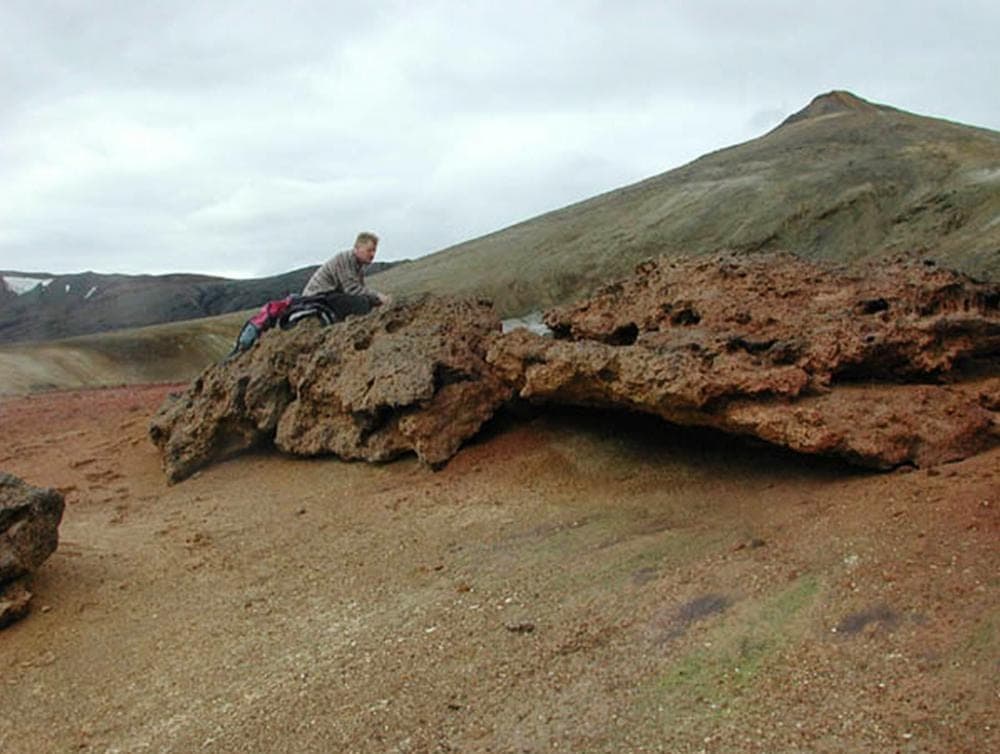
Mild high-temperature alteration is also about 10 km south-west of Vonarskarð, in the fracture system that runs south-west from Vonarskarð. In the middle of Vonarskarð there is a low ridge, a short way north-east of Deili. The ridge is very greatly altered. What is remarkable about that alteration is that epidote is found in it, which indicates 250°C temperature. Signs of such high temperature at the surface have not been found before. This indicates that the alteration took place during the cooling of an eruptive formation under a glacier.
No geophysical measurements have been carried out in Vonarskarð, and so the real size of the thermal system is uncertain.
Source: Haukur Jóhannesson, ÍSOR.