

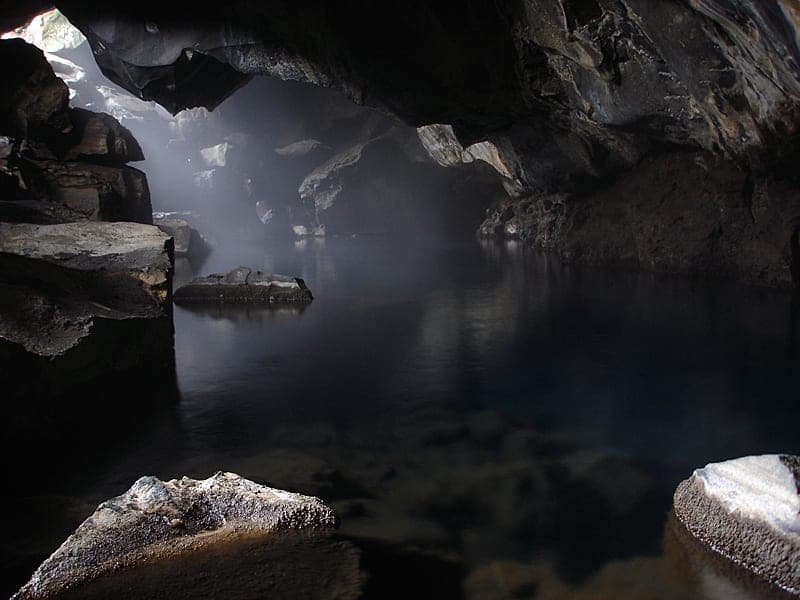
Deep-water-mixed outflow in surface strata is known from Námafjall, that is, in fissures and in springs out in front of Reykjahlíð. The high silica content indicates the origin. It is likely that warm water emerging from beneath lava in Kelduhverfi is outflow from the high-temperature areas at Þeistareykir and in Gjástykki. The warm water layer is shallow and colder beneath. On the Reykjanes peninsula deep-water-mixed outflow is not known with certainty. A shallow, brackish water layer at Húsatóftir and at Reykjanes (the sea pool) may, however, be of that kind. Outflow from the Hengill area found its way north into Þingvallavatn.
Found at: Mývatn
Steam from hot groundwater
Steam can rise off hot groundwater streams in lava fields or where there are porous strata. This is best known to the west and south of Jarðbaðshólar in Mývatnssveit. Another example is in the Torfajökull area in Dómadalshraun and at the northern end of Tjaldfell to the south-west of it. The steam is completely odourless in these cases. The same applies to steam in the lava at the southernmost and northernmost parts of the Þeistareykir area.
Found at: Reykjanes, Eldvörp, Svartsengi, Sandfell, Trölladyngja, Hveravellir, Landmannalaugar, Austur-Reykjadalir, Köldukvíslarbotnar, Hverarönd/Námafjall, Bjarnarflag, Krafla, Gjástykki, Þeistareykir