

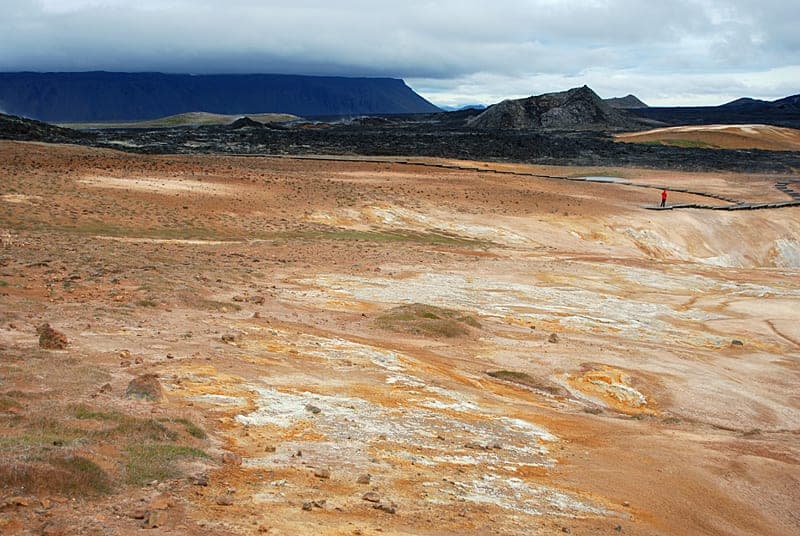
Geothermal heat and geothermal signs are on a belt that lies across it, in the middle of the caldera, from Hrafntinnuhryggur in the east and west into Krókóttuvötn. Springs are only in the eastern half of the caldera and the graben. Explosion craters and large clay formations from the present (Hvannstóð and Krókóttuvötn) bear witness to powerful spring activity in the westernmost part of the caldera, although it is now cold. The main feature of the geothermal area in Krafla is the explosion craters ("hydromagmatic"), both because of their size (a few hundred metres in diameter) and because of how beautifully shaped they are and how easily traceable the ejecta is, and that refers to the youngest ones, Hvannstóð and the craters around Víti. In addition to them, pure steam-explosion craters occur, but much smaller.
As in other high-temperature areas, the Krafla area mainly has mud and steam pots, but there is also a fair amount of sulphur mounds, especially south on Krafla. In many places connections of geothermal activity with fault fractures are seen, such as in Leirhnjúkur, Vítismór (it is cold there now) and south on Krafla.
Volcanic activity in the Krafla area in the present has passed in two cycles with a 4000-5000 year pause between. The later cycle began about 3000 years ago with a fissure eruption that reached from Hverfell north into Gjástykki. Five fissure eruptions followed, of which three in historical time. Three times it erupted on the middle swarm where Leirhnjúkur is the main landmark, once on the Dalfjall swarm and twice on the arc-fracture system on the north-east side of the caldera. Pumice and steam-explosion eruptions accompanied some of the fissure eruptions. Some of the remains of these eruptions are shown to tourists, that is, springs, lavas and craters in Leirhnjúkur, and Víti and its accompanying small craters with mud pots and thermal patches.
The production areas of Krafla power station in the Krafla slopes are defined on the basis of drilling and are named Suðurhlíðar, Hveragil and Leirbotnar. The area of these three subareas is only about 2 km2, yet the variability is such that part of it is not usable because of persistent effects of magmatic gases. This applies to the deep system of the Leirbotnar area, which reaches north into Vítismór. At the same time the geothermal system there is divided in two. The upper part reaches down to a little over 1000 m depth and is about 200°C hot, but the lower part is over 300°C, and it is hardly feasible to produce from both parts of the system in the same borehole. The Hveragil fracture is very productive with good physical properties and almost dry steam to be had at best. Finally there are Suðurhlíðar, which follow almost the boiling-point temperature curve with depth, but only average wells in capacity. This might be borne in mind when assessing other possible production areas, some of which are many times larger.
Future production looks to the so-called western area of Krafla, that is, the geothermal heat in the graben south of Leirhnjúkur and south of Sátur. There is geothermal heat there in several places, but the land is almost all covered by lava that flowed in the Mývatn fires. There are no remarkable rock formations there, only variations in the lava. Nearby, however, are all the more noteworthy phenomena where there is the fracture area in Þríhyrningar and Dalfjall with dissected and downfaulted gravel terraces that were once level.
The western area lies south of the main geothermal strip, and it is likely that this is outflow from it that seeks into the fracture area and south between the caldera halves, since there is nothing in the volcanic activity that indicates an accumulation of magma as a heat source beneath. Areas comparable to this are known from elsewhere, and this could well prove productive and probably shallow.
Source: Kristján Sæmundsson, ÍSOR.