

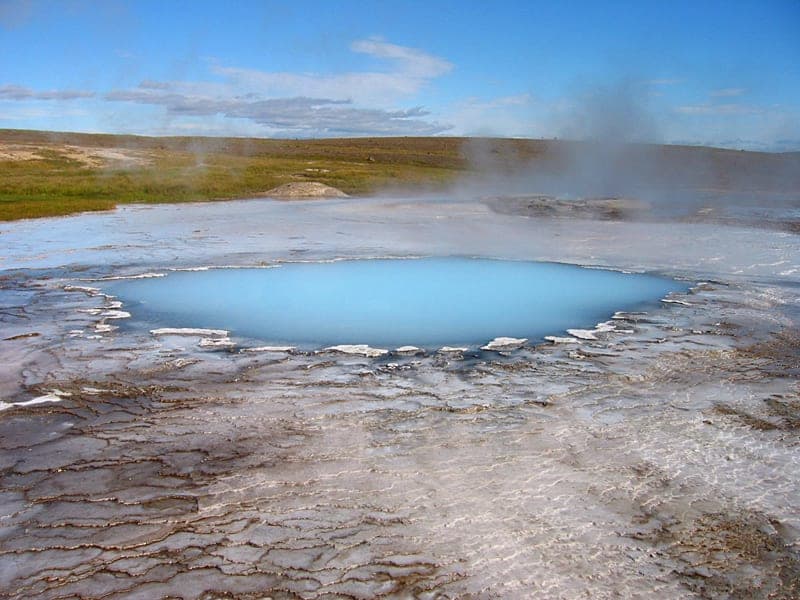
Classification of surface geothermal heat into deep-water springs or springs with chloride-rich water:
Silica springs
The groundwater in the high-temperature areas contains much dissolved matter, especially silica. Where such water comes to the surface the silica precipitates out and forms mounds of silica sinter around the spring vents. The largest sinter sheets are a few hectares in size. Examples are Hveragerði, the Sandar by Geysir, and Hveravellir. The terraced rims on the sinter mounds are undamaged at Hveravellir but worn by trampling and weathered at the Geysir area. Silica springs occur in deep gully gorges in the vicinity of Landmannalaugar, but there is little sinter around them.
Silica springs can be found at: Grændalur/Hveragerði, Geysir, Hveravellir, Landmannalaugar
Deep-water-mixed pools
Pools in high-temperature areas where deep water and cold groundwater mix together. The deep-water origin is recognised by the high silica and chloride content of the water. The pools occur in the area around Landmannalaugar and west of Námafjall. Landmannalaugar springs out from beneath Laugahraun where the land is lowest. Pools of this origin also emerge from the river gravels nearby. West of Námafjall the water in the fissures is of this origin.
Deep-water-mixed pools can be found at: Landmannalaugar, Öxarfjörður
Geysers
Geysers are unstable phenomena, strengthening with earthquakes but subsiding in between. Geysir strengthened with the earthquakes of 1896 but stopped erupting of its own accord in 1916. Geysers have appeared at Reykjanes during earthquakes but have been short-lived. The Silica Hill