

The eruptive formations in the Hengill area are varied. The main types of eruption sites, however, are only two, linked to fissure eruptions and shield eruptions. Crustal movements in a rift belt, as there have been in the Hengill area throughout the whole time its geological history spans, show themselves in fissures and faults and tilted strata in the marginal areas. The South Iceland seismic belt extends from the east into the Hengill area.
In the western part of the Hengill area the landscape is shaped by eruptive formations that have built up in the last glacial period and in the present. In the east, by contrast, erosive forces have shaped it.
Loose strata cover the lowland, and mountain slopes are nowhere very landslide-covered except where there are thick lava layers in the edges or the mountains are entirely of pillow lava. Concerning the water regime in the Hengill area, it divides in two. In its western part there are steady springs and streams only where the strata are so altered that they hold water. Otherwise all water there sinks into the ground. In the eastern part of the area rivers and streams flow year-round.
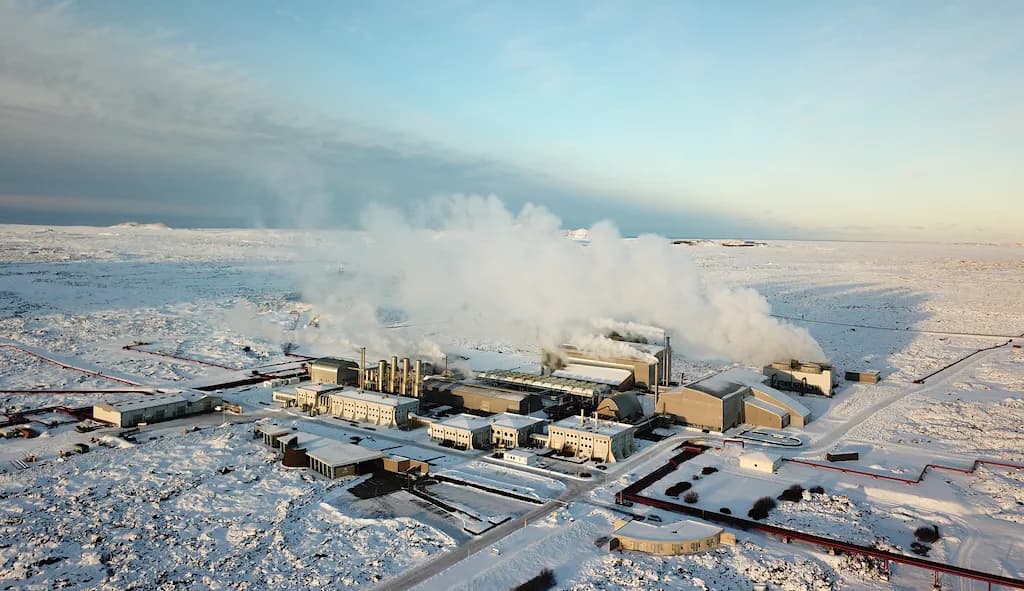
The Hengill area is among the largest geothermal areas in the country, about 100 km2. It is not, however, all one and the same boiling pot, but is at least divided into three:
The landscape in the area is mountainous, and the utilisation of geothermal heat depends greatly on access to the respective areas. The geothermal areas are also variably suitable for utilisation, which depends mainly on temperature and carbon-dioxide content.
Source: Kristján Sæmundsson, ÍSOR.
- The south-easternmost part of it is in the Hveragerði volcano (Grændalur). It has ceased eruptions and is already somewhat eroded. Drilling in Hveragerði and up along Varmá has shown that there is outflow there from a hotter area farther north or north-west. Production beyond what the present boreholes give would therefore be based on drilling in Grændalur. If any special feature of this area were to be named, it would be the silica springs in Hveragerði and at Reykir, or the numerous pools that spring out from rock slides in Grændalur. Among them are steam vents that often follow fractures linked to South Iceland earthquakes. There are many examples of spring changes in this area, both ancient and recent. The area is conveniently low in the landscape, about and below 200 m. Access requires road-building over the landslides on the west side of the valley without spoiling springs or pool areas.
- The Ölkelduháls area stands out for the carbon-dioxide pools that are in a cluster from Ölkelduháls south into Reykjadalur and in Hverakjálki. The geothermal heat there follows an eruption swarm with tuff mountains of varying age and a single lava crater, Tjarnarhnúkur. Access is easy and in fact a power-line road up onto Ölkelduháls already exists.
- Finally there is the geothermal area in Henglafjöll. It extends from Nesjavellir south-west into Hveradalir and Hverahlíð. The geothermal heat is greatest and most continuous on the outside of Hengill everywhere except on the north-west side. Sulphur springs are greatest in the west of Henglafjöll, that is, in Sleggjubeinsdalir, north of Innstidalur and above Hagavíkurlaugar. On the east side calcareous springs and carbon-dioxide pools are common. The geothermal heat in Henglafjöll may possibly be divided into several production areas, all of which could be in mutual pressure connection: Nesjavellir, Sleggjubeinsdalur, Hellisheiði, Hverahlíð, Þverárdalur, Innstidalur and Fremstidalur.