

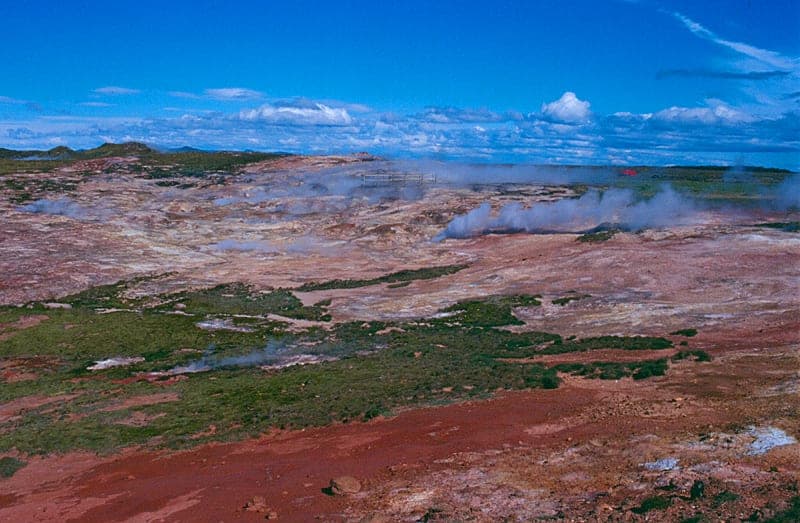
Two eruption fissure swarms lie over the "heel" at Reykjanes, and the geothermal heat is on the eastern one between Skálafell and Litla-Vatnsfell. Farther west is the Stampar swarm with the youngest lavas. There is no geothermal heat on it, but resistivity measurements indicate that the geothermal system extends to it as well.
At Reykjanes many geological phenomena are found that are worth seeing. Most outstanding is a tephra crater with dykes where the Stampar craters run out into the sea. In the geothermal area geysers have appeared now and then, in fact twice in the last century in connection with earthquake swarms. They erupt geothermal seawater but have proved short-lived.
More long-lived has been a geyser in the so-called Silica Hill, which is now inactive. It is of tuff with a metre-thick silica crust on top. There one can also see a fracture that tore itself open in an earthquake swarm 35 years ago and still looks fresh where it runs north-east from Gunnuhver. What gives the Reykjanes area its greatest value is the awareness that the plate boundary of the Reykjanes Ridge comes ashore there.
Tourists who go out to Reykjanes stop by Valahnúkar to look at the surf and by Gunnuhver, which is a cluster of mud pots north below the Silica Hill.
Settlement at Reykjanes has left traces (the lighthouse keeper's farm and the new farm Hveravellir). Gardening has long been practised, material has been taken for roads, drilling and factory operation have been carried out, and so much has been disturbed. New phenomena have arisen. The most notable of them are the silica terraced rims west below Rauðhólar in the outflow from the salt factory.
The Reykjanes area is one of the best-researched high-temperature areas in the country. The foundation for that research was laid in the years before 1970. A powerful earthquake swarm had just then taken place and with it life came into the springs. Since then the activity has waned considerably.
The Reykjanes area is among the hottest used in this country. Thirty years of production have had no detectable effect on the reserves in the geothermal system. The chemical content of the geothermal seawater creates difficulty in utilisation but also a saleable product, though so far not at a profit.
Source: Kristján Sæmundsson, ÍSOR.