

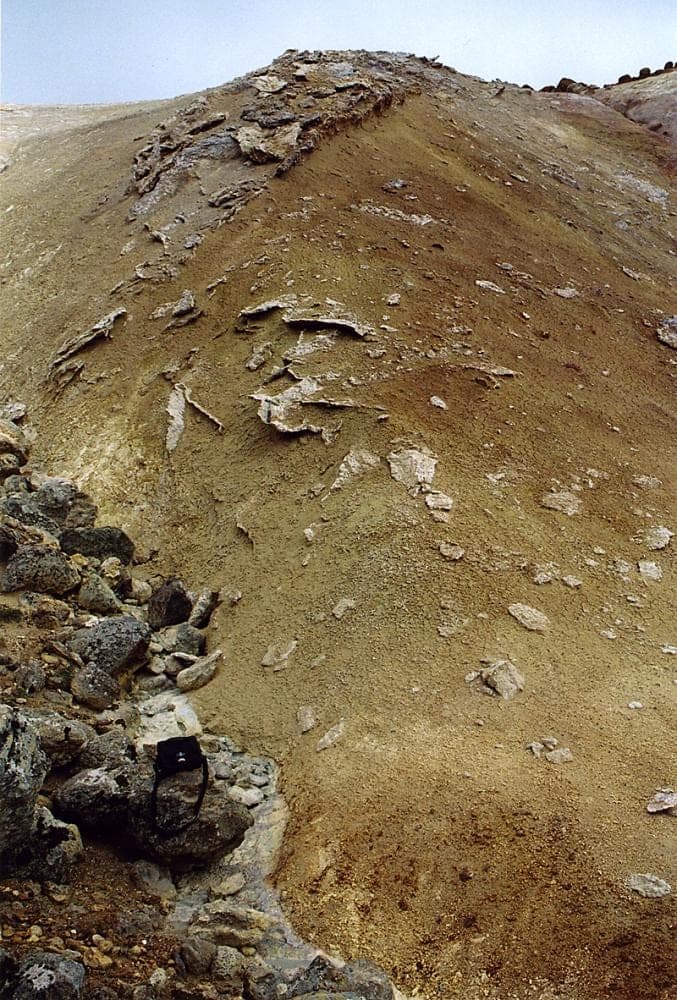
Gypsum crusts and crystals bear witness to the oxidation of H2S during alteration of rock, which precipitates gypsum with dissolved Ca in water. There is a fair amount of gypsum in active steam-vent areas such as at Námafjall, in Krafla and Krýsuvík.
Silica sinter
Silica sinter is found in several geothermal areas where there are no water springs now, for example at Hverinn eini, at Reykjanes and inside Geysir, or higher up in the country than they are now known (for example at the outer edge of Grændalur and above Reykir in Ölfus).
Geothermal iron
Geothermal iron (that is, hematite) forms loose lumps in some geothermal areas, often where the activity has passed but generally where alteration is great. Notable find sites of geothermal iron are in Torfajökull, Grændalur and Vonarskarð.
Extinct spring bowls
Extinct spring bowls are common in cold clay flats and patches, sometimes where there is no geothermal heat nearby, such as at Oddnýjarhnjúkur and east below Rauðfossafjöll. All of this is young and bears witness to spring activity in the present. Cold patches are found in most steam-vent areas. The largest, cold clay flat is in Hrúthálsar.
Extinct geysers
Bowls in silica sinter. Examples: Hvítimelur north of Geysir and Litli geysir above Hveragerði.
Cold clay flats
Cold clay flats are areas where geothermal heat has boiled the rock into clay but are now cold. Examples of such flats are at Oddnýjarhnjúkur on Kjölur, in Hrúthálsar and Leirhóll at Krafla.
Alteration in eroded areas
Alteration in eroded areas occurs where spring activity reaches back to the Ice Age and lava has not covered it. In most there is still geothermal heat in some form. The Sog in Trölladyngja and the small valleys north of Hveragerði are handy examples. The same applies to the eastern part of the Torfajökull area, the caldera in Tindfjöll and Heilagsdalsfjall on the west side of the Fremrinámar system. The richness of colour is great where the erosion reaches deepest.
Surface alteration
Surface alteration at temperatures higher than 250°C is known only in Vonarskarð. There high-temperature minerals (epidote and others) are in little-eroded pillow-lava ridges (found by Guðmundur Ómar Friðleifsson and Haukur Jóhannesson). The hot water has sought up through channels in the pillow lava, but in between the rock is fresh. There is no geothermal heat in these ridges now, but in other formations nearby. About 400 m of water depth has been needed to keep boiling down at this temperature.