

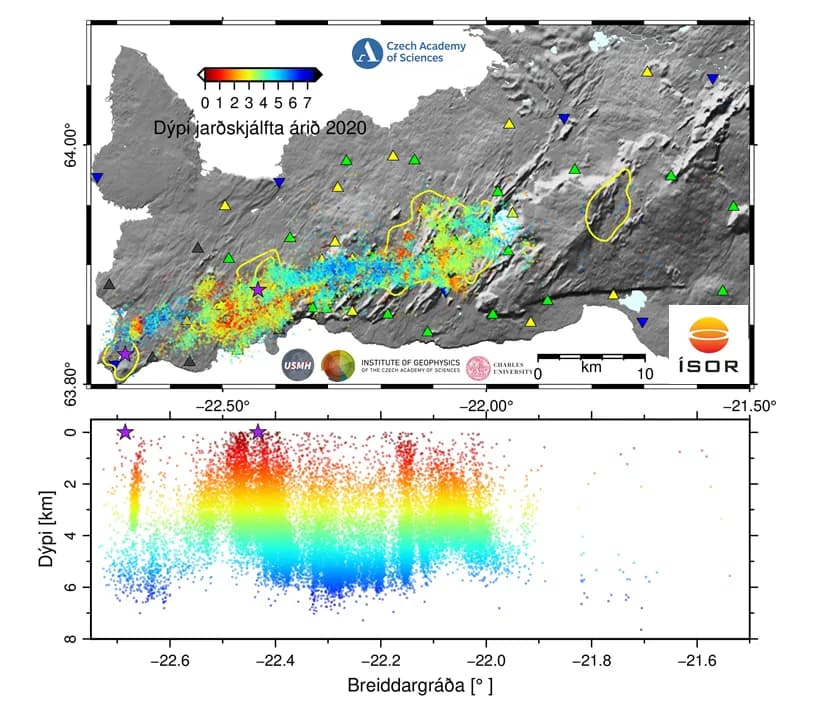
NASPMON is a four-year collaborative project between Iceland and the Czech Republic; specifically ÍSOR and two institutes within the Czech Academy of Sciences (CAS), as well as the Faculty of Science of Charles University in Prague. The NASPMON project builds on decades of informal cooperation between ÍSOR and CAS; the Academy has operated 15 seismometers on the Reykjanes Peninsula in collaboration with ÍSOR since 2013.
– "NAtural Seismicity as a Prospecting and MONitoring tool for geothermal energy extraction"
NASPMON (2021-2024)
About the project
The aim of the project is: a) to further develop and improve knowledge of the physical processes that cause earthquakes, with special emphasis on the role of fluids, the activation and utilisation of geothermal energy, and plate movements; b) to apply the results to develop guidelines for activity in seismically active areas; c) to test and develop seismic-research methods for geothermal prospecting; d) to increase and strengthen the scientific capacity of the research institutions in the participating countries. The project is divided into eight work packages and ÍSOR leads three of them: i) data acquisition and data storage; ii) automatic processing and location of earthquakes; iii) interdisciplinary interpretation. Within NASPMON, ÍSOR's seismic team has the opportunity to further develop its knowledge and skills, which further increases the team's ability to take on new projects in a field where progress is rapid. The project can be followed on its website and on Twitter.
In this project we have a unique opportunity to work with data from the great rifting area that the Reykjanes Peninsula is, exactly as things are happening. The eruptions on the Reykjanes Peninsula have had a major impact on the project, and formal cooperation and data-sharing agreements have been established with various foreign universities and institutions, and many peer-reviewed scientific papers have already been produced in this collaboration. As an example, since February 2021 eight instruments have streamed data in real time to the Icelandic Met Office and played a key role in natural-hazard monitoring on the Reykjanes Peninsula over the past year or so.
Collaboration and funding
The project is funded by the Kappa research programme, the fund of the European Economic Area and Norway (https://www.tacr.cz/en/kappa-programme/).
Partners alongside ÍSOR:
Institute of Geophysics, Czech Academy of Sciences: https://www.ig.cas.cz/
Institute of Rock Structure and Mechanics, Czech Academy of Sciences: https://www.irsm.cas.cz/
Faculty of Science, Charles University: https://www.natur.cuni.cz/eng
ÍSOR project manager: Þorbjörg Ágústsdóttir