
News
Iceland's continental shelf rights confirmed on the Reykjanes Ridge
ÍSOR · 21 March 2025 · 3 min read
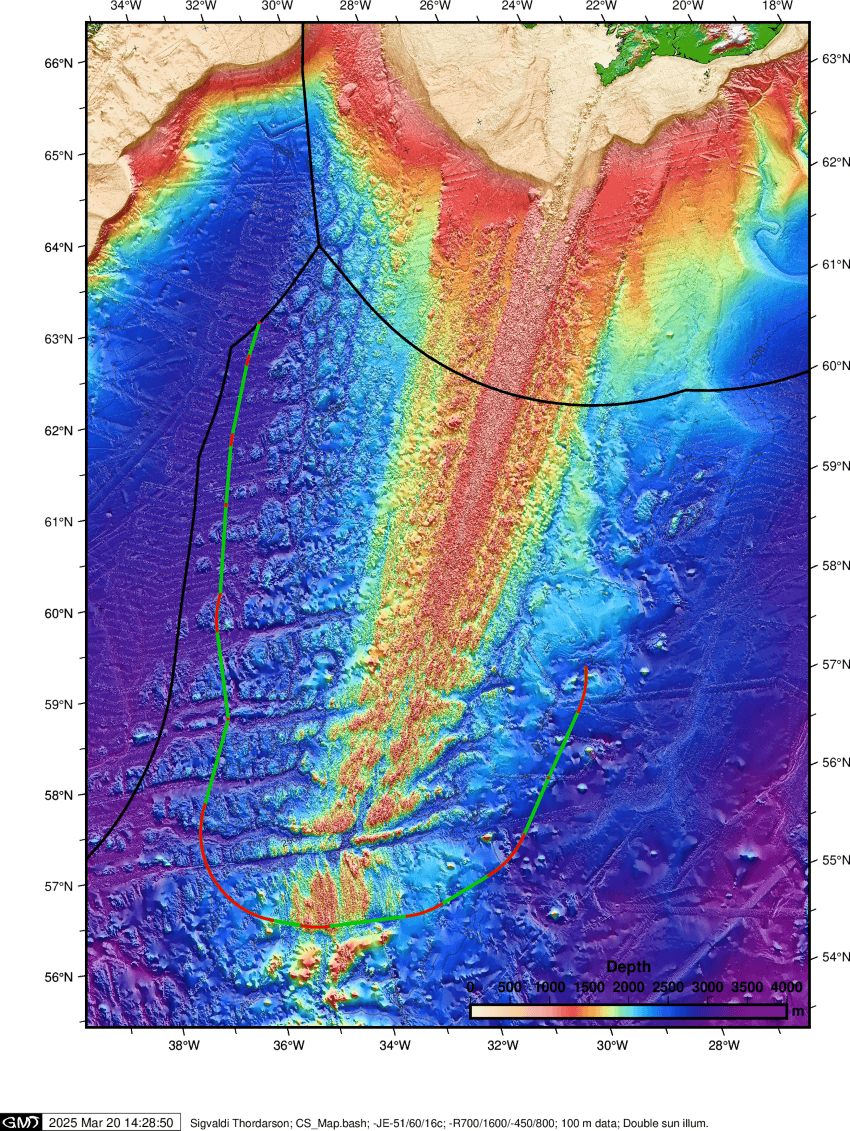
On 14 March, the United Nations Commission on the Limits of the Continental Shelf approved the proposals for the outer limits of Iceland's continental shelf on the western, southern and southeastern parts of the Reykjanes Ridge. With that, a long process to this point came to an end; Iceland's…
On 14 March, the United Nations Commission on the Limits of the Continental Shelf approved the proposals for the outer limits of Iceland's continental shelf on the western, southern and southeastern parts of the Reykjanes Ridge. With that, a long process to this point came to an end; Iceland's submission for this area, in addition to an area east of Iceland in Ægisdjúp (Smugan), was first submitted in 2009.
Preparation of this project began just after the last turn of the century, and a vast amount of scientific data was collected so that it would be possible to complete the work on the submissions to be filed to delineate the continental shelf. The Research Division of the National Energy Authority (Orkustofnun), and later ÍSOR, was entrusted with overseeing the scientific processing of the work, and many ÍSOR employees have been involved in this project, in addition to parties from the Institute of Earth Sciences at the University of Iceland.
The data that was collected specifically for this project are, on the one hand, bathymetric data and, on the other hand, seismic measurements of strata. The Marine Research Institute handled the collection of the bathymetric measurements; these are multibeam bathymetric measurements that were collected in the years 2002–2004 (Reykjanes Ridge, Ægisdjúp and Hatton-Rockall) and yielded excellent data for this processing. The requirements are to a large extent based on topographic features, that is, where the slope descends to the deep sea, where, with mathematical calculations, the so-called foot of slope is found, located where the sharpest change in gradient is in that area. Foreign parties were called upon to collect seismic measurements of strata, which took place in 2003–2004, and data was collected on the eastern part of the Reykjanes Ridge, Ægisdjúp, the Iceland-Faroe Ridge and on the southern part of the Hatton-Rockall area. These data, both reflection and refraction measurements, provide further information about the structure of the crust and sedimentary layers and can prove necessary to confirm connections from the country over to the areas that are being claimed, or to use sediment thickness to extend the limits of the continental shelf.
This specific data collection and processing of the data is probably one of the most extensive that the Icelandic state has conducted and financed. In addition to these data, the project benefited from access to research expeditions that took place on the Reykjanes Ridge, in particular multibeam bathymetric measurements, gravity and magnetic measurements that were carried out around the so-called Bight Transform Fault in 2013, conducted by a group from the University of Hawaii together with the University of Iceland and other parties; these measurements were of great use to the project in the dialogue with the subcommission of the Commission on the Limits of the Continental Shelf that dealt with Iceland's submission.
In addition to the data that was specifically collected for this project, the scientific group drew on numerous studies that have been carried out by international scientific teams on Iceland's continental shelf, and they also mattered greatly in ensuring this good outcome.
Over the past year or so, a dialogue and cooperation has been ongoing with the subcommission of the UN Commission on the Limits of the Continental Shelf under the guidance of the Ministry for Foreign Affairs to complete the delineation of this part of the Reykjanes Ridge, and geoscientists from ÍSOR and the Institute of Earth Sciences at the University of Iceland have provided the Ministry for Foreign Affairs with assistance in those matters. That dialogue concluded in November 2024 with a joint conclusion of both parties, which then still had to receive the endorsement of the Commission as a whole.
Our formal final presentation to the Commission was then held on 7 March last, and it was therefore very gratifying to receive the news that the Commission had approved the proposals so shortly after that presentation.
As is pointed out in the Ministry for Foreign Affairs' announcement on the matter, The Government | Successful conclusion of the United Nations Commission on the Limits of the Continental Shelf regarding Iceland's continental shelf on the Reykjanes Ridge, it is important that Icelanders secure for themselves as extensive a continental shelf area as possible, because although it is not known with certainty what resources are present there according to current knowledge, that situation can change completely with the technological advances that the future holds.
"Congratulations on this, dear countrymen" – Iceland's right to the continental shelf and resources of the Reykjanes Ridge recognized – RÚV.is