
News
The flexible couplings are in the well!
ÍSOR · 26 February 2025 · 3 min read
So-called flexible couplings (Flexible Couplings) have been in development at ÍSOR for the past ten years; they are a new solution intended to solve a problem that occurs in boreholes when they heat up, as the casings in the wells can be damaged due to thermal expansion. Recently a major milestone…
So-called flexible couplings (Flexible Couplings) have been in development at ÍSOR for the past ten years; they are a new solution intended to solve a problem that occurs in boreholes when they heat up, as the casings in the wells can be damaged due to thermal expansion. Recently a major milestone was reached in the project when the flexible couplings were installed for testing in the new production well NJ-37, which Jarðboranir is drilling for Orka náttúrunnar at the Nesjavellir power plant.
ÍSOR, Orka náttúrunnar and Orkuveitan are working together on the development and testing of the flexible couplings, and ÍSOR received the IGC (Iceland Geothermal Conference) Innovation Award last spring for the design of the flexible couplings and was nominated by the European Geothermal Energy Council for an innovation award this year. The flexible couplings are an Icelandic patent-protected design by ÍSOR and they were manufactured at Vélvík.
The flexible couplings are designed to reduce the stress generated due to thermal expansion that arises in the cemented steel casings of high-temperature boreholes. Stresses that arise during heating in most cases far exceed the yield strength of the steel, which means that the material is deformed. By using flexible couplings, this stress generation is prevented by allowing about 15–20 mm of displacement in each pipe, and thus the material is kept below the yield strength. Great hopes are pinned on these new flexible couplings significantly reducing the likelihood of damage to casings, which has been a considerable problem until now.
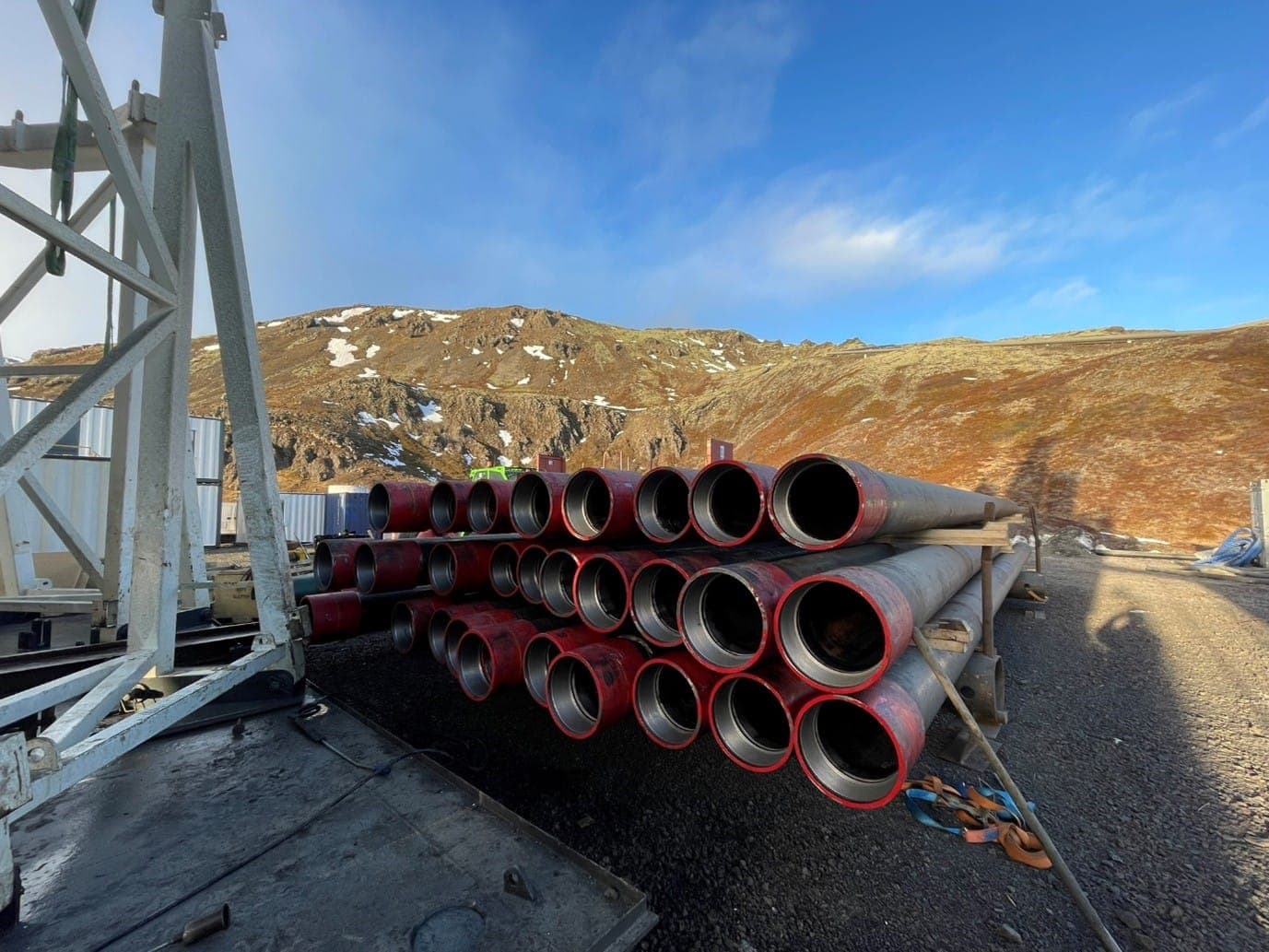
In order to increase the reliability of the structure, conventional casing couplings are replaced with flexible couplings. The casings of high-temperature boreholes consist of about 12 m long steel pipes that are screwed together and form a casing that, in conventional wells, is 800–1200 m long. During drilling, the well is kept cold by circulation pumping of drilling fluid, but when drilling is stopped and the well is ready, it heats up and the steel begins to expand due to thermal expansion. The temperature of high-temperature boreholes varies depending on the area and depth but is most often in the range of 250–300°C. The flexible couplings were designed and developed at ÍSOR in the research projects GeoWell and DEEPEGS, which were supported by the European Union's Horizon 2020 program. They were function-tested under real conditions in an experiment at the surface in collaboration with Orkuveitan, ON, Landsvirkjun and HS Orka in the GEOTHERMICA project GeConnect (2019–2022).
In the new production well at Nesjavellir, the first production of flexible couplings, or about 67 units, was installed in the production casing of the borehole. This is a notable milestone in the journey of the flexible couplings, but by proving the technology in a borehole, one comes closer to the goal of using the technology for superheated deep-drilling wells where the production temperature could be in the range of 450–550°C. ÍSOR is a participant in the research project COMPASS, which is supported by the European Union's Horizon Europe program and is led by Orkuveitan and Orka náttúrunnar. In the project, the aim is to improve the design of deep-drilling wells as preparation for the drilling of the deep-drilling well IDDP-3.
In the video below, you can see experts from ÍSOR, Orka náttúrunnar and Orkuveitan go over in more detail the role of the flexible couplings and what problems they can solve.