
News
Where and how do earthquakes form?
ÍSOR · 17 May 2021 · 5 min read
Where and how do earthquakes form? What effect do geothermal utilization, fluid flow and crustal movements have on seismic activity? These are questions that, among other things, it is hoped will be answerable in a research project that recently got under way at ÍSOR. The results of the project…
Where and how do earthquakes form? What effect do geothermal utilization, fluid flow and crustal movements have on seismic activity? These are questions that, among other things, it is hoped will be answerable in a research project that recently got under way at ÍSOR. The results of the project will, among other things, be used to prepare guidelines on how geothermal production and injection should be carried out with regard to seismic activity in active seismic areas, but within the project various kinds of processing of seismic data in geothermal research will also be tested and developed.
The research project is called NASPMON (NAtural Seismicity as a Prospecting and MONitoring tool for geothermal energy extraction). This is a collaborative project of Icelanders and Czechs; more precisely ÍSOR and two divisions within the Czech Academy of Sciences (CAS) – the Institute of Geophysics (IG) and the Institute of Rock Structure and Mechanics (IRMS) – as well as the Faculty of Science of Charles University (CU), and it is for four years. The project can be followed on its website and on Twitter.
Gylfi Páll Hersir, geophysicist, leads the project here in Iceland. It is supported by the Kappa research programme, a fund of the European Economic Area and Norway.
The project is divided into eight work groups, and ÍSOR leads three of them:
- Project Management (VP1)
- Data acquisition and data archiving (VP2) – Egill Árni Guðnason
- Automatic Data Processing: detection and location of earthquakes (VP3) – Þorbjörg Ágústsdóttir
- Seismic activity: Time and space analysis (VP4)
- Earthquake Source Mechanisms and stress analysis (VP5)
- Crustal Seismic Models (VP6)
- Ground motion model: Input for hazard assessment (VP7)
- Multi-Disciplinary interpretation (VP8) – Gylfi Páll Hersir
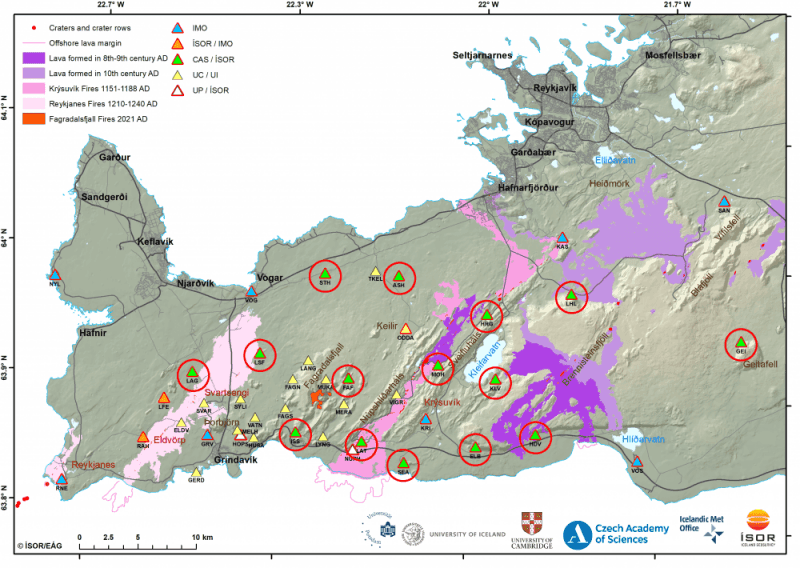
ÍSOR has worked with the Czech Academy of Sciences (CAS) since 2013, and the Academy has operated 15 seismometers on the Reykjanes peninsula in collaboration with ÍSOR. The meters (data from eight of them are streamed in real time to the Icelandic Meteorological Office from ÍSOR under a special agreement), along with 8 meters from the Icelandic Meteorological Office, have played a key role in natural-hazard monitoring on the Reykjanes peninsula over the past year.
ÍSOR has also monitored seismic activity in other high-temperature areas in the country and built up knowledge of equipment for monitoring it, including the selection of suitable seismic sensors and recording devices along with the setup of measuring stations. Seismic data are now usually streamed in real time through wireless networks and GSM technology to ÍSOR's offices. Power is obtained with wind turbines and solar batteries.
According to Gylfi Páll, this project is extremely important for the seismic group at ÍSOR. Here the group has the opportunity to further develop its know-how and skills, which further increases the group's possibilities of tackling new projects in a field where progress is rapid. It is also very exciting to get the opportunity here to work with data from this great unrest area that the Reykjanes peninsula is, precisely when things are happening. There are many who envy us this project and the data we will be working with in the coming years.
To explain even better the importance of knowing earthquakes and their causes, here a shorter text from Gylfi Páll Hersir on earthquake research, which appeared in ÍSOR's Annual Report 2019, is presented.
Seismic waves are of two kinds. On the one hand of our making (active seismics) and on the other hand of natural cause (passive seismics).
Earthquakes of our making, where we have control over the source, are produced by creating seismic waves at the Earth's surface, either with explosions or heavy blows. The seismic waves travel through the crust at different speeds depending on the type of the rock strata, and the travel time is recorded with a seismic sensor and recording device. The travel time provides important general information about the structure of the crust and the upper part of the mantle. Most often the seismic sensors are kept at the Earth's surface. This method has, however, not proved particularly useful in research on high-temperature areas, because of the number of inclined lava layers near the surface. In the IMAGE research project, which ÍSOR took part in some years ago, an attempt was made to lower seismic sensors down two deep boreholes in the Krafla area and record seismic waves from earthquakes that were created. This method (VSP) worked well and gave valuable information but is rather costly.
Earthquakes of natural cause. Over the course of time, stress energy accumulates in the rock due to pressure, mainly because of plate movements of the crust but also for other reasons, e.g. magma movements. When the stress approaches the breaking strength of the rock, it takes just the right final push for the rock to break in an earthquake. The injection of borehole fluid can often be this final push, as happened for example at Húsmúli near Hellisheiði power plant in 2011 and led to considerable seismic activity. Then one speaks of induced seismicity. Induced earthquakes are in some places used to open fractures and thereby create better permeability.
It has become more common here as abroad to collect seismic data from high-temperature areas, both as an important element in surface research and also to monitor the responses of the geothermal system to production and injection. Seismic measurements are, along with resistivity and gravity measurements, the geophysical methods that are most used in the exploration of high-temperature areas and are useful for obtaining a clearer picture of the structure and properties of the area, including where it is most promising to locate boreholes with regard to good permeability. The overall picture of geothermal systems is based precisely on the results of many geoscience disciplines but not least on their joint interpretation.
Earthquakes can be used to map active fractures, but there one often finds the feeder channels of the geothermal fluid rather than in those fractures that are older and inactive. It may be said that seismic activity together with increased permeability is the foundation of geothermal production. In its simplest form, the source mechanisms of earthquakes describe movement on the fracture on which the earthquake occurred. Thus the source mechanisms indicate whether fractures open or whether it is only a matter of parallel movement of the fracture surfaces. Earthquakes also give information about the depth to the surface where the rock ceases to break because the crust has become ductile due to high temperature and is no longer brittle (brittle/ductile transition). This isothermal surface often domes up beneath high-temperature areas, and earthquakes below it are infrequent. There the heat source of the geothermal system is usually to be found.