
News
Precursors of the eruption at Fagradalsfjall
ÍSOR · 3 May 2022 · 4 min read
On 2 May 2022 an article appeared in one of the world's most respected geoscience journals, Nature Geoscience, on the results of research on the unrest episode that began at Svartsengi early in 2020 and was a precursor of the eruption at Fagradalsfjall. The article, for which Ólafur G. Flóvenz…
Precursors of the eruption at Fagradalsfjall
On 2 May 2022 an article appeared in one of the world's most respected geoscience journals, Nature Geoscience, on the results of research on the unrest episode that began at Svartsengi early in 2020 and was a precursor of the eruption at Fagradalsfjall. The article, for which Ólafur G. Flóvenz, former CEO of ÍSOR, is the lead author, is the product of two years of research work by specialists of ÍSOR and GFZ, Germany's foremost geoscience institution (Deutsches GeoForschungsZentrum in Potsdam).
The article is based essentially on three kinds of measurements on the Reykjanes peninsula in 2020: i) InSAR measurements from the European Space Agency's Sentinel-1 satellite, which showed three cycles of alternating uplift and subsidence at Svartsengi and a fourth cycle at Krýsuvík; ii) precise seismic measurements with both conventional seismometers and the fibre-optic cable of the telecommunications company Míla, which was converted with new technology into a dense network of seismometers; and iii) precise measurements of changes in the Earth's gravity that reflect the mass of the material that may have intruded into the geological strata and caused the uplift.
The main conclusion of the article is that the uplift was most likely caused by high-pressure gas (carbon dioxide) that intruded in three batches into a water-conducting layer at about 4 km depth beneath the geothermal system at Svartsengi in January, March and May 2020, and a fourth batch beneath the geothermal system at Krýsuvík in August of the same year. The pressure of the gas was each time high enough to cause the uplift, but over time the carbon dioxide dispersed along the water-conducting layer, which led to the subsequent subsidence. By using "poroelastic" model calculations, the uplift and subsidence could be reproduced precisely and the volume of the material that entered the aquifer could be calculated. By using the results of the gravity measurements, it was possible to calculate the density of the material that caused the uplift.
The results show that 0.11 ± 0.05 km³ of material with a density of 850 ± 350 kg/m³ intruded in total beneath the geothermal system at Svartsengi. By comparison it may be mentioned that the density of cold water is 1000 kg/m³ and of magma about 2700 kg/m³. Although the results indicate strongly that the material that intruded was first and foremost carbon dioxide, the results do not rule out that some magma could have been carried along with the gas.
Research by specialists of the Institute of Earth Sciences of the University of Iceland indicates that the magma that came up in the eruption at Fagradalsfjall comes from 15-20 km depth at the top of the Earth's mantle, while the boundary of mantle and crust is at about 15 km depth in these parts. At this place, magma that comes from deeper in the mantle is accumulating, while at the same time it is degassing, that is, giving off carbon dioxide. From the volume of the gas that intruded beneath Svartsengi and Krýsuvík in 2020, one can calculate how much magma would have had to degas to produce this amount of carbon dioxide. The calculations indicate that the volume of the magma at 15-20 km depth beneath Fagradalsfjall is at a minimum 2-9 km³. Only a tiny part of that magma came up in the eruption at Fagradalsfjall, or 0.15 km³. It follows from this that the amount of magma beneath Fagradalsfjall is still sufficient for much more voluminous eruptions than occurred in 2021.
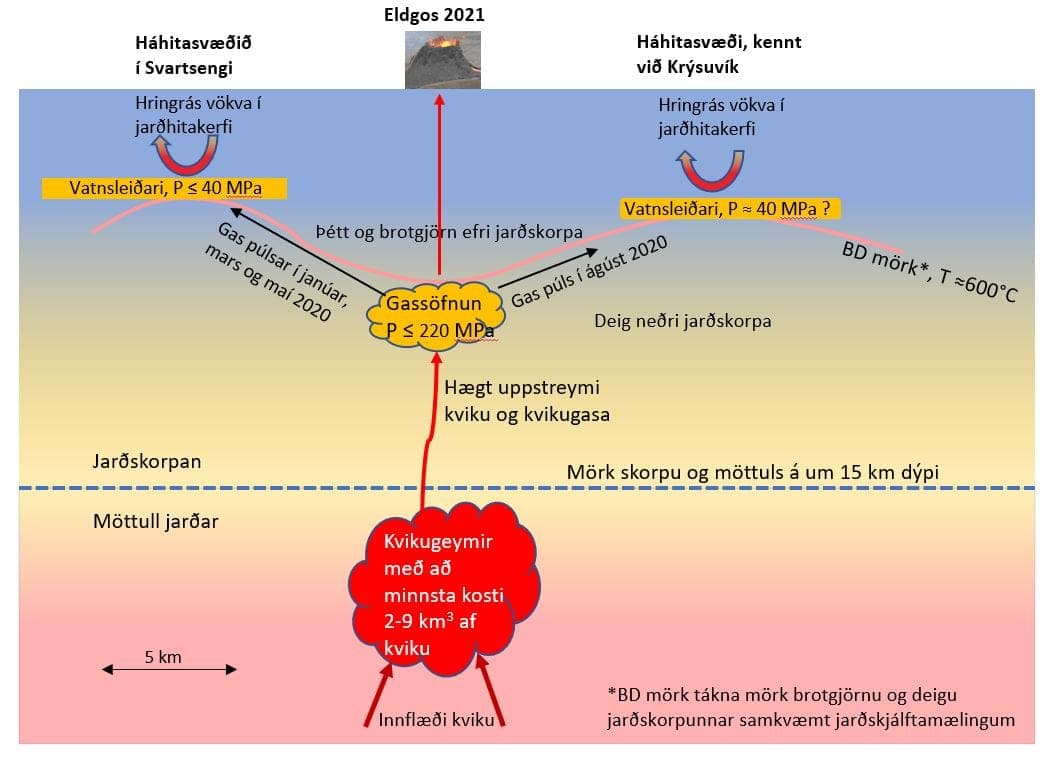
On the basis of the research, a conceptual model of the sequence of events that led to the eruption is presented, as shown in the accompanying explanatory figure. The model assumes that magma had for some time flowed deep from the Earth's mantle and accumulated at the top of the mantle at 15-20 km depth beneath Fagradalsfjall. There carbon dioxide is released from the magma and moves toward the surface. It has an easy path through the ductile lower part of the crust but stops at about 7 km depth where it reaches the brittle and dense part of it. There the gas accumulates temporarily until a certain volume is reached. Then the gas begins to flow obliquely upward along the boundary of the brittle and dense crust toward the place where that boundary lies shallowest, which is beneath the nearby high-temperature areas at Svartsengi and Krýsuvík, where deep, low-pressure aquifers are also to be found. The gas enters the aquifer and increases the pressure there sufficiently to lift the rock above and cause uplift and associated seismic activity. When a certain amount of gas has drained from the storage area beneath Fagradalsfjall, the channel to the high-temperature areas closes, but opens again when sufficient gas has accumulated there once more.
The conceptual model explains well the sequence of events in the run-up to the eruption, including the alternating cycles of uplift and subsidence, the seismic activity and the changes that were measured in the Earth's gravity. The model is also consistent with the observations that have been made of the chemistry of the magma that came up in the eruption.
The article can be accessed on the website of the journal Nature: https://www.nature.com/articles/s41561-022-00930-5