
News
Scientific articles by Icelandic geoscientists in the journal Nature
ÍSOR · 19 September 2022 · 3 min read
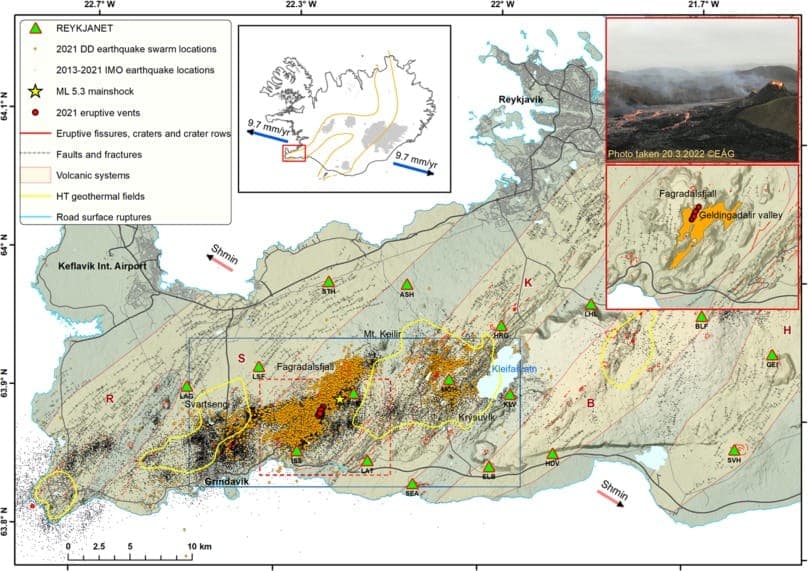
In the journal Nature, two articles by Icelandic geoscientists appeared recently, both of which deal with the upheavals at Fagradalsfjall in 2021. One of the articles is geophysical and ÍSOR was a participant in it, while the other is geochemical. It is extremely rare for two scientific articles by…
In the journal Nature, two articles by Icelandic earth scientists recently appeared, both of which deal with the upheavals at Fagradalsfjall in 2021. One of the articles is geophysical, and ISOR was a participant in it, while the other is geochemical. It is extremely rare for two scientific articles by Icelandic scientists to appear in the same issue of Nature, as competition for publishing material there is extremely fierce and great demands are made on the content. The findings of the articles concern the precursor of the eruption at Fagradalsfjall last year, which was different from the precursor of many other eruptions in the world, and the chemical composition of the lava and how it changed as the eruption progressed.
Below is a short discussion of the geophysical article.
The scientific article bears the title „Deformation and seismicity decline before the 2021 Fagradalsfjall eruption“ and deals with the lead-up to the eruption and how it differs from the precursor of many eruptions in the world. The article was produced under the leadership of Freysteinn Sigmundsson, scientist at the Institute of Earth Sciences of the University of Iceland, and Michelle Parks, specialist in crustal movements at the Icelandic Meteorological Office. A number of other scientists also contributed to it, including from ISOR, along with scientists from Britain, New Zealand and the Czech Republic. As most people are surely aware, the ground shook considerably on the Reykjanes Peninsula in the weeks before the eruption began. The period was therefore characterised by stress release in the crust, but in the very last days before the eruption, crustal movements and seismic activity in the area around the eruption sites decreased. This is unlike the lead-up to eruptions in many places in the world, which are often characterised by increasing crustal movements and earthquakes shortly before an eruption when magma pushes its way up to the surface.
The scientists point out that this behaviour of the volcano at Fagradalsfjall can be explained by the interplay of magma movements and plate movements. When magma pushes its way up through the crust in the lead-up to eruptions, these forces can be released with accompanying earthquakes and crustal movements. If seismic activity decreases, it may possibly indicate that this process is coming to an end and that magma will reach the surface of the earth.
Over a period of just over three weeks before the eruption at Fagradalsfjall, there was both major deformation of the ground and many earthquakes. Both were linked to the formation of a vertical magma dike that reached from the surface down to just over 8 km depth. At the same time, energy was released from the crust that had built up due to movements of the crustal plates. So-called triggered earthquakes occurred in nearby areas, up to magnitude 5.6.
The article points out that the milder seismic activity in the last days before the eruption may possibly be attributed to the fact that the magma had by then come very close to the surface, where the crust is weakest and the stresses therefore smaller. In this respect, the seismometers of the Czech Academy of Sciences and ISOR on the Reykjanes Peninsula played a key role; they are operated within the NASPMON research project, which is funded by the Kappa programme of the EEA fund.
The results of the research have significance for the international community and can be of use to institutions that carry out volcano monitoring around the world, in interpreting data related to seismic activity. The research also shows that the interplay of volcanoes and forces in the crust associated with plate movements must be taken into account when predicting possible eruptions. Decreasing deformation, reduced seismic activity and stress release due to plate movements can therefore be a precursor of certain types of eruptions.
The two articles can be accessed on the Nature website:
Deformation and seismicity decline before the 2021 Fagradalsfjall eruption: https://www.nature.com/articles/s41586-022-05083-4
Rapid shifting of a deep magmatic source at Fagradalsfjall volcano, Iceland: https://www.nature.com/articles/s41586-022-04981-x