
News
Alexandra K. Hafsteinsdóttir receives the President of Iceland's Innovation Award and Hugo Alejandro Arteaga Vivas a special recognition for projects carried out at ÍSOR
ÍSOR · 21 January 2026 · 4 min read
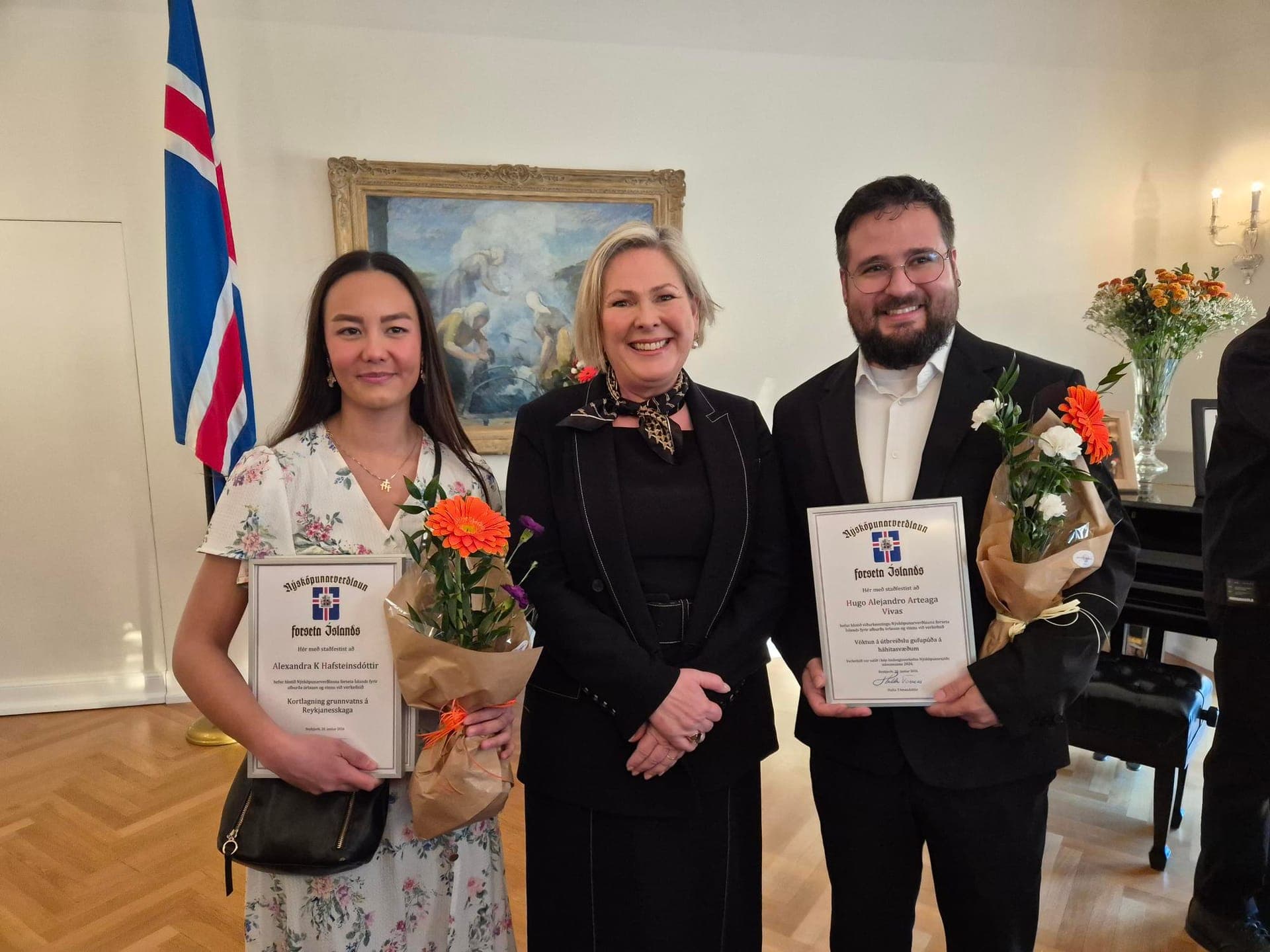
Alexandra K. Hafsteinsdóttir, a student in the master's program in geology at the University of Iceland and an employee of ÍSOR, received the President of Iceland's Innovation Award for her project Mapping of groundwater on the Reykjanes Peninsula. In addition, Hugo Alejandro Arteaga Vivas, a…
Alexandra K. Hafsteinsdóttir, a student in the master's program in geology at the University of Iceland and an employee of ÍSOR, received the President of Iceland's Innovation Award for her project Mapping of groundwater on the Reykjanes Peninsula. In addition, Hugo Alejandro Arteaga Vivas, a student in the master's program in geophysics at the University of Iceland, received a special recognition from the President of Iceland for the project Monitoring of the extent of steam caps in high-temperature areas.
Both projects were carried out at ÍSOR and are based on research that has important value for the monitoring and utilization of natural resources in Iceland.
The awards were presented by Halla Tómasdóttir, President of Iceland, at a ceremonial event at Bessastaðir on Tuesday 20 January 2026.
Mapping of groundwater on the Reykjanes Peninsula – Alexandra K. Hafsteinsdóttir
The aim of Alexandra's research was to map groundwater currents on the Reykjanes Peninsula by measuring conductivity (salinity) and analyzing anions in fresh water at various places on the peninsula, while at the same time developing a procedure around a new electric water pump. Twenty-four samples of groundwater were taken at various places on the peninsula in the summer of 2025 from shallow fresh-water boreholes. In ten boreholes, samples were taken with the new pump, which has acquired the nickname "Perlufestin" (the Pearl Necklace). It is an exceptionally convenient and compact tool for sampling, unlike conventional water pumps, which are bulky, heavy, and powered by large generators.
The Pearl Necklace is well suited for sampling from narrow fresh-water wells into which a conventional borehole pump cannot be fitted, and it is easy to carry it on foot between locations that are otherwise inaccessible. Conductivity and anions were measured in the water samples, and the results of the analyses were presented on maps showing their distribution across the peninsula. The results agree well with previous studies of the peninsula's hydrology. There are clear boundaries between water areas, which are linked to the different bedrock in each area. The ninth eruption in the Sundhnúkur crater row began during the conduct of the research. A number of samples were taken in close proximity to the eruption sites while it was ongoing, and they were compared with older data from the area. The results of the chemical analyses of the samples that were taken do not indicate that the volcanic activity has had a significant effect on the chemical composition of the groundwater, and there is little to no change in the chemical content of the groundwater in the area since the start of measurements.
Alexandra's supervisors were Sveinborg Hlíf Gunnarsdóttir, Finnbogi Óskarsson, Auður Agla Óladóttir and Sigurður Garðar Kristinsson, geologists at ÍSOR.
Monitoring of the extent of steam caps in high-temperature areas – Hugo Alejandro Arteaga Vivas
In high-temperature areas under production, hot water and steam are extracted from the ground through boreholes, and the steam is used to drive turbines for electricity generation. Over time, production can lead to an increase in the amount of steam and the formation of a so-called steam cap due to a pressure drop in the geothermal system. Until now, there has been no direct way to monitor the development of such steam-cap formation other than individual measurements in boreholes. In a recent paper by Pilar Sánchez-Pastor et al. (2023), a method is demonstrated that uses so-called seismic noise to continuously monitor changes in the amount of steam in geothermal systems. Seismic noise can be measured with seismometers, and the premise of the method is that seismic waves travel more slowly through steam-saturated areas than water-saturated ones.
The aim of the project was to use and further develop this method based on continuous measurements of seismic noise. In the project, programs were developed for data processing and graphical presentation, and they were applied to three years of seismic data from several seismic stations in the vicinity of a geothermal production area at Hellisheiði.
It was possible to successfully reproduce previous results that are consistent with the measured pressure drop and land subsidence caused by production in the area. The project thus demonstrated that this method can be used to monitor changes in the amount of steam in geothermal areas continuously and economically. The next steps are to develop and test the method in other geothermal areas under utilization.
Hugo's supervisors were Þorbjörg Ágústsdóttir, geophysicist and expert in seismic research, Egill Árni Guðnason, geophysicist, and Rögnvaldur L. Magnússon, physicist at ÍSOR, together with Pilar Sánchez-Pastor at GEO3BCN.
The President of Iceland's Innovation Award was first presented in 1996.
The board of the fund for 2023–2026 consists of: Björgvin Stefán Pétursson, chairman, appointed without nomination; Sævar Helgi Bragason, nominated by the Science Committee of the Science and Technology Council; Ásdís Jóhannesdóttir, nominated by the Federation of Icelandic Industries; Alexandra Briem, nominated by the Association of Local Authorities in Iceland; and Erla Guðbjörg Hallgrímsdóttir, nominated by the National Union of Icelandic Students.
The awards are given to those students who have done outstanding work on solving projects that were funded by the Student Innovation Fund in 2025, and the fund falls under the Ministry of Culture, Innovation and Higher Education.
Announcement of the Student Innovation Fund